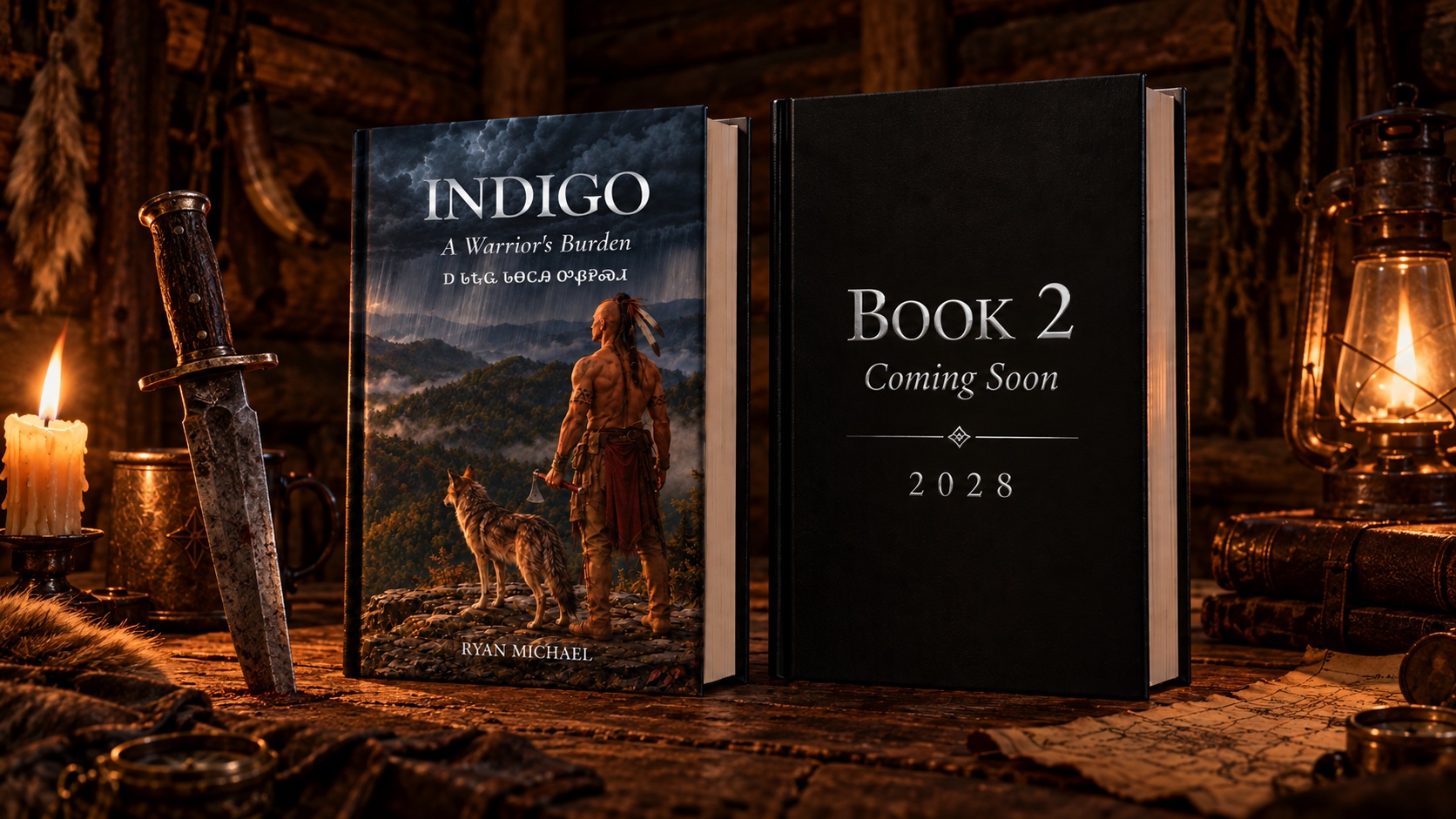
INDIGO
A Warrior's Burden The Price of Peace
Cherokee Symbol - A Warrior's Burden Cherokee Symbol - The Price of Peace
A story the living earth refuses to bury Old men buy Young men pay
Book One
A Warrior's Burden Full Wrap
Back Cover Blurb
The Indigo Series
Coming Soon
Coming Soon
Enter the World of Indigo
The Warrior
Yona Canon
Yona Equa – Blurb
Yona Is Scary Reconcile Give Thanks
Old men buy
Young men pay
Those He Loved Most
Ahyoka Dinigatiya
Ahyoka Dinigatiya
Ditsiktoli Jusgosdi
Ditsiktoli Jusgosdi
Gvnagei Equoni
Gvnagei Equoni
Immokalee Gayehi
Immokalee Gayehi
Kanati Eluwei
Kanati Eluwei
Sasa Gohiyuhi
Sasa Gohiyuhi
Usdi Inoli & Astila Tski
Tsiyu Gansini
Tsiyu Gansini

ABOUT THE AUTHOR

Ryan Michael is a historical fiction author whose work explores loyalty, identity, sacrifice, and the spiritual bond between people and the land that shapes them.

His debut series, Indigo, is set in the eighteenth-century Appalachian frontier during the bloodiest decades of colonial expansion. Drawing heavily from historical records, Cherokee oral traditions, frontier geography, and years of research into early America, the series follows those forced to navigate a world where peace often demanded surrender, and survival came at the cost of everything they loved.

But at its heart, Indigo is about loyalty to what the heart holds sacred. It is about the bonds of brotherhood forged through grief, loss, sacrifice, and impossible choices. It is about how different perspectives can fracture a people from within long before enemies arrive from beyond their borders. And beneath it all runs a deeper current—the belief that the living earth calls certain souls during times of great upheaval. Rebellious spirits willing to accept lives marked by grief and loss, if only to slow the turning wheels of time long enough for the living earth to embrace the Aniyvwina for one final generation.

Ryan Michael lives in Michigan with his wife, twin sons, and dog. By profession, he works in manufacturing and operational leadership, where discipline, precision, and responsibility shape his daily life. Outside of that world, he spent years immersed in the history and landscape that would eventually become Indigo—studying eighteenth-century Cherokee history, frontier warfare, Appalachian geography, colonial trade, indigenous cosmology, and walking in the moccasins of the men who fought the turning wheels of time and lost.

Indigo did not begin as an outline or a publishing goal.

It began as an experience Ryan still struggles to explain completely.

After a profound moment during a guided meditation, followed days later by an unexpected flood of inspiration while listening to Cherokee cultural historian J.P. Johnson, the foundation of the story arrived almost fully formed: a family, a people, and a young Cherokee warrior named Yona Equa standing at the edge of a world beginning to break apart around him.

What followed took years of research, revision, and historical reconstruction, folding documented history around the emotional core of the story that first revealed itself to him in those moments.

The result became Indigo—a story about loyalty to the people, places, and truths that remain long after maps, borders, and treaties attempt to erase them.

Some stories are written. Others are carried.